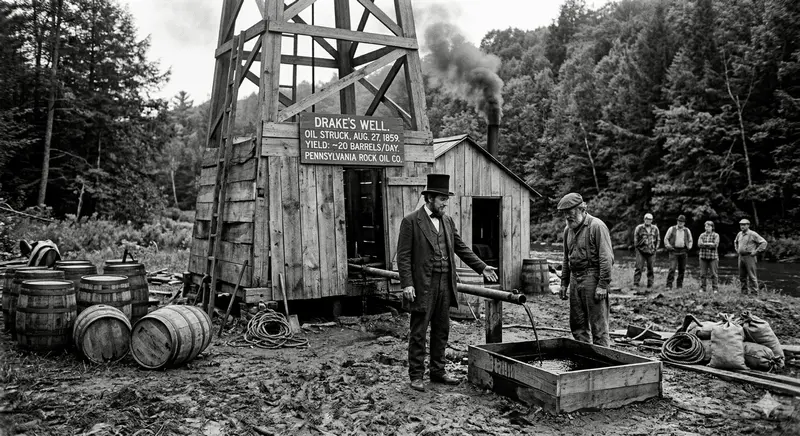
When standard histories discuss the "Birth of the Oil Industry," they focus almost exclusively on Drake’s Well in Titusville in 1859. They describe the ingenuity of the derricks and the initial surprise of the "black gold."
But for the Kinzua Gazette and the deep memory of the Allegheny Plateau, that was only the preamble. The true black gold rush—the moment a quiet, subsistence-farming region exploded into a global economic engine—began 16 years later and 50 miles east, when the massive Bradford Oil Field was tapped in 1875.
This wasn't a gentle introduction. It was a chaotic, muddy, and dangerous transformation that overnight created the modern industrial architecture of the Plateau.
Forests of Derricks
To look at the Kinzua Valley today, blanketed in a seamless, wild canopy of hemlock and hardwood, it is impossible to imagine the landscape of 1885. Where hikers now seek solitude, a different kind of forest once stood.
In less than a decade, thousands of wooden derricks sprouted across the mountains. The sound of solitude was replaced by the constant, rhythmic chug-chug-chug of steam engines, the crash of drilling tools, and the crackle of teamster whips. Archival photos (like the one displayed here) show a landscape utterly overwhelmed by industry, with derricks crowding so densely they often touched, marching up impossibly steep hillsides and choking every stream and hollow.
The Bradford Field did not just produce a little oil; it produced 90 percent of the nation's entire supply by 1881. The wealth generated here was staggering, fueling gilded age fortunes in Pittsburgh and New York.
Life on the Mud Line
While the oil scouts and bankers chased wealth, the actual work of the Plateau was defined by mud. Moving heavy, cumbersome drilling rigs, casing pipe, and steam engines over roadless mountain passes required teams of six or eight horses. The "teamsters" who drove them were rugged, profane, and essential. A wagon slipping in the knee-deep mud could crush horses or halt a drilling operation, making the teamster the indispensable (and well-paid) hero of the rush.
Life was rough. Boomtowns like "Tarport" and "Petrolia" materialized in weeks, built of unpainted green lumber. They were places defined by gambling, saloon brawls, and sudden, explosive wealth, contrasting sharply with the quiet, established farming communities they displaced.
A Legacy We Live Upon
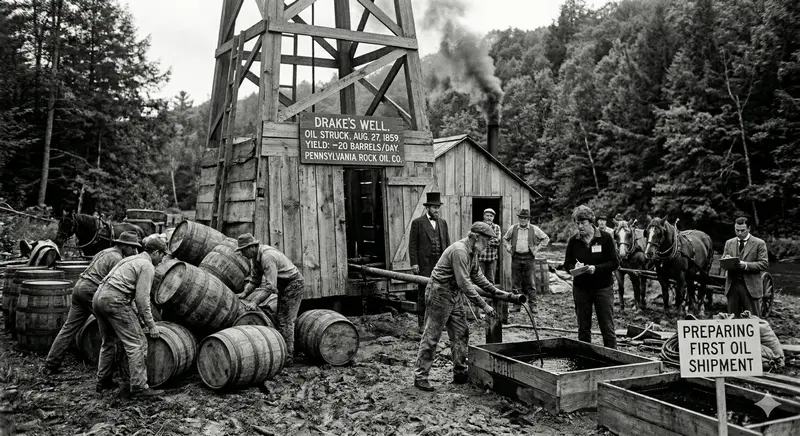
We celebrate "Oil 150" not just because it was an economic miracle, but because it created our foundation. The oil rush financed the rapid rail expansion that connected the Plateau to the world. It built the brick and stone main streets that define Warren, Bradford, and Kane.
It also created a landscape of contradictions. The rush was a magnificent industrial achievement, but one built upon the sudden, ruthless extraction of natural resources. As we look at the quiet forest today, we are, in a very real way, looking at a "post-oil" landscape—a testimony to the forest's ability to reclaim its ground, even after the most violent human rush has faded.