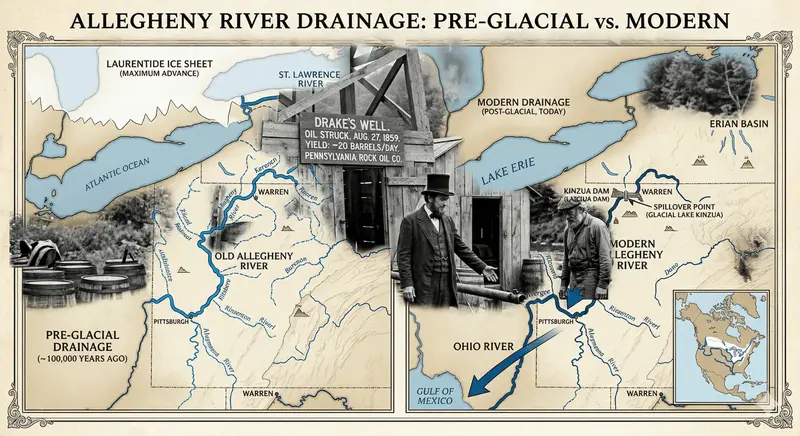
To stand on the Rimrock Overlook and watch the Allegheny River snake through the deep, timbered throat of the Kinzua Valley is to witness a landscape that, by all rights of geology, shouldn't exist. The river looks permanent, a timeless fixture of the plateau. But the water we see today is a newcomer—a "pirate" that only claimed this territory after a violent, icy confrontation that reshaped the map of North America.
Before the last Great Ice Age, the Allegheny was a fundamentally different creature. It didn't flow south toward the Ohio and the Gulf of Mexico. Instead, it was part of a northern drainage system. The "Old Allegheny" flowed toward what is now Lake Erie and out through the St. Lawrence River to the Atlantic.
The Glacial Dam
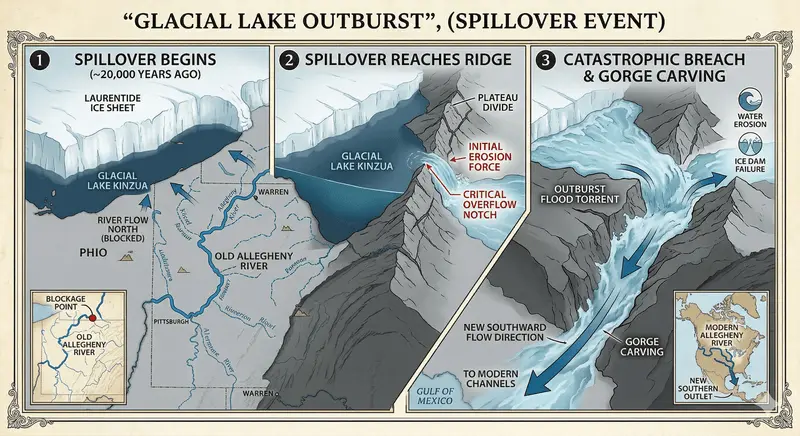
The turning point arrived roughly 20,000 years ago with the advance of the Laurentide Ice Sheet. This wall of ice, over a mile thick in some places, marched south until it reached the very edge of our plateau. It acted as a colossal, immovable dam across the river's northern exit.
As the ice blocked the path, the water had nowhere to go. The Kinzua Valley and the surrounding lowlands transformed into a massive, rising inland sea. Geologists call these "proglacial lakes." The water rose higher and higher against the ridges of the Allegheny Plateau, searching for an escape.
A Act of River Piracy
Eventually, the trapped water reached a "spillover point"—a low notch in the southern divide. With the weight of an entire inland sea behind it, the water didn't just trickle over the ridge; it tore through it.
This process, known as Glacial Lake Outburst, was catastrophic. The surging water carved deep, narrow "v-shaped" notches into the plateau, effectively "stealing" the river from its northern route and forcing it into a new, southern channel. This is why our gorges are so remarkably steep and narrow compared to the rolling hills just outside the glacial border. The river was quite literally forced to cut a new path through solid stone in a geological heartbeat.
The Legacy in the Current
This history of "river piracy" is why the Allegheny Reservoir is so uniquely suited for the Kinzua Dam today. The steep, high walls of the gorge—carved by that ancient, desperate overflow—provided the perfect natural container for the modern reservoir.
When you launch a boat or cast a line into the Allegheny today, you are traveling a path born of ice and rebellion. The river doesn't just flow; it follows a scar left behind when the world was frozen, a reminder that on the Allegheny Plateau, even the water has a history of survival.