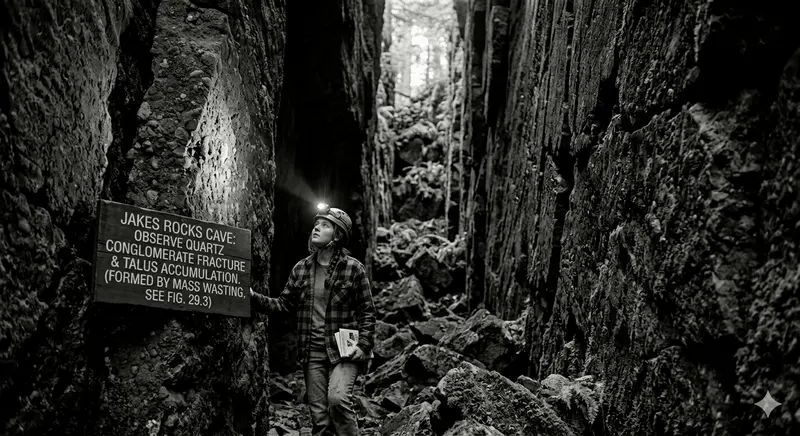
To most visitors, Jakes Rocks is a place of breathtaking vistas—a series of stone balconies overlooking the shimmering Allegheny Reservoir. But for the adventurous, the real story of this landscape isn't the view; it’s the labyrinth of darkness hidden just beneath the rim.
These are the Talus Caves, a network of deep crevices and "rock cities" that represent a plateau in the slow-motion act of pulling itself apart.
The Geology of "Mass Wasting"
The rocks here are composed of Oleam Conglomerate, a incredibly hard sandstone filled with milky quartz pebbles. While the stone itself is durable, the layer of shale beneath it is soft and prone to erosion.
Over millions of years, water seeps into the vertical joints (cracks) of the conglomerate. When that water freezes, it expands with enough force to nudge multi-ton blocks away from the main cliff face. This process, known as Mass Wasting, creates deep, narrow "corridor caves." These aren't limestone caverns carved by acid; they are mechanical "unzippings" of the earth’s crust.
The "Wolf Mouth" and the Natural Cold
Because these crevices are deep and narrow, they act as natural cold-air traps. Even in the sweltering humidity of a Pennsylvania July, the air at the bottom of a Jakes Rocks crevice can be 20°F cooler than the surface.
Historically, these "refrigerators of the wild" were essential habitats. Local folklore speaks of the "Wolf Mouth," a specific formation where the last of the plateau’s timber wolves supposedly denned in the 1800s. While the wolves are long gone, the caves still host a "palaeo-climate." Look closely at the walls, and you will see rare, luminous mosses and ferns that date back to the post-glacial era, thriving in the permanent damp and dark.
Navigating the Rock City
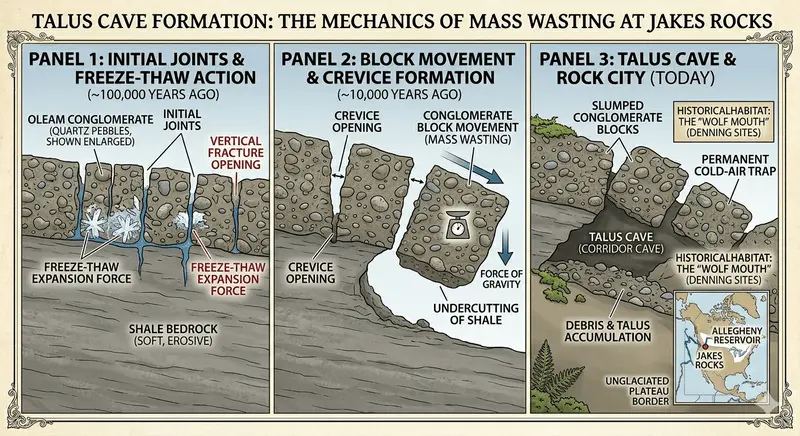
For hikers today, the "Rock City" at Jakes Rocks offers a masterclass in plateau architecture. Walking between these massive, moss-covered walls feels like navigating the alleyways of a ruined stone city. It is a reminder that the Allegheny Plateau is not a static object—it is a living, shifting structure, slowly shedding its skin one massive block at a time.